






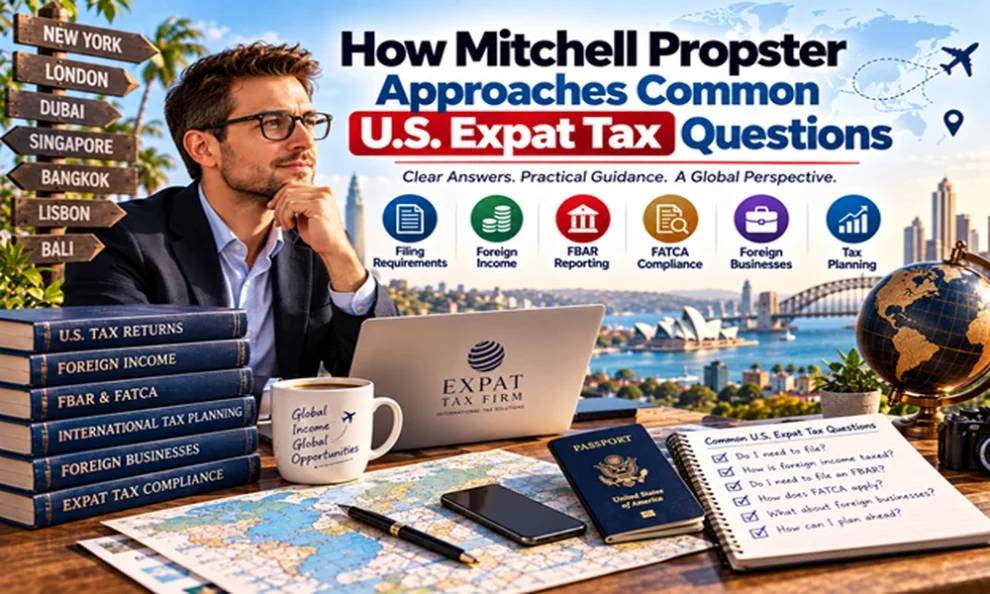

For Americans living, working, or running businesses outside the United States, tax questions can become more complicated when foreign income, financial accounts, and business interests enter the picture. The United States generally taxes citizens and resident aliens on worldwide income, regardless of where they live. At the same time, Americans abroad may have additional reporting requirements that do not typically apply to taxpayers living entirely within the United States.
Mitchell Propster is associated with Expat Tax Firm, where the firm’s publicly available information identifies him as its founder and lists him as a CTC and Team Leader. The firm provides services relating to U.S. expat tax returns, foreign income reporting, FBAR filing, FATCA compliance, foreign corporations, and expat tax planning.
Looking at the questions Americans abroad commonly face provides a useful way to understand the areas that require careful attention.
Do Americans Living Abroad Still Have to File U.S. Tax Returns?
One of the first questions many Americans ask is whether moving permanently to another country ends their U.S. tax filing obligations.
Generally, it does not.
According to the IRS, U.S. citizens and resident aliens abroad are generally subject to the same basic income tax filing rules as those living in the United States. Their worldwide income is generally considered when determining their U.S. tax obligations. Filing requirements depend on factors such as income, filing status, and age.
That means earning a salary from a foreign employer, operating a business overseas, receiving investment income, or earning other income outside the United States does not automatically remove the requirement to consider a U.S. return.
For someone approaching an expat tax question, the first step is therefore often understanding the complete financial picture rather than focusing only on where the person currently lives.
How Is Foreign Income Treated?
Another common question concerns income earned outside the United States.
An American living overseas may receive wages in a foreign currency, operate as a freelancer, own a foreign business, or receive rental or investment income from another country. These sources can create additional reporting considerations on a U.S. tax return.
The IRS states that U.S. citizens and resident aliens are generally subject to U.S. tax on worldwide income. Certain taxpayers abroad may qualify for provisions such as the Foreign Earned Income Exclusion or the Foreign Tax Credit, but eligibility and reporting requirements depend on the individual’s circumstances.
This is an area where assumptions can create problems. Paying tax in another country does not necessarily mean a person can simply ignore the income on a U.S. return. Instead, taxpayers need to determine which U.S. reporting and tax provisions apply to their particular situation.
What Is FBAR and Why Does It Matter?
Foreign bank accounts are another frequent source of questions.
The Foreign Bank and Financial Accounts Report, commonly known as FBAR, is generally required when a U.S. person has a financial interest in, or signature or other authority over, certain foreign financial accounts and the aggregate value of those accounts exceeds $10,000 at any point during the calendar year. The report is filed electronically through the Financial Crimes Enforcement Network’s system.
Importantly, the reporting requirement is not based simply on whether an account generated taxable income. A foreign account can potentially create an FBAR obligation even when it did not produce taxable income.
For Americans abroad, this makes maintaining accurate records of foreign accounts particularly important.
How Is FATCA Different From FBAR?
FATCA is often confused with FBAR because both involve foreign financial information.
The two requirements, however, are separate. FATCA can involve Form 8938, Statement of Specified Foreign Financial Assets, when a taxpayer meets the applicable reporting thresholds. The thresholds and filing requirements can vary depending on factors such as whether the taxpayer lives in the United States or abroad and whether they file jointly.
FBAR, meanwhile, is a separate foreign account reporting requirement administered under the Bank Secrecy Act. In some circumstances, a taxpayer may have obligations under both systems.
Understanding that distinction can help prevent the common assumption that completing one foreign-account report automatically satisfies every other reporting requirement.
What About Foreign Businesses?
Foreign business interests can introduce another layer of complexity.
The IRS identifies several information returns that may apply to U.S. persons with interests in certain foreign entities. Depending on the structure and circumstances, forms such as Form 5471 for certain foreign corporations, Form 8865 for certain foreign partnerships, or Form 8858 for certain foreign disregarded entities or foreign branches may become relevant.
This is one reason business owners living abroad may need to look beyond their individual Form 1040. The structure of a foreign business, ownership percentage, transactions, and other details can influence which reporting obligations apply.
Where Does Tax Planning Fit In?
Tax planning is not simply about preparing a return after the year has ended. For Americans abroad, decisions made during the year can affect their eventual tax reporting.
Changes in residence, employment, investments, business structures, foreign accounts, or sources of income may all be worth considering before filing season.
Expat Tax Firm publicly lists expat tax planning among its services, alongside expat tax returns, business taxes, streamlined filing compliance, FBAR and foreign reporting, and FATCA compliance.
For taxpayers looking for additional professional information, Mitchell Propster can be found through his LinkedIn profile, while Expat Tax Firm provides information about its international tax services and team.
A Practical Approach to Expat Tax Questions
The recurring theme across these questions is the importance of looking at the complete financial situation.
Rather than asking only, “Do I have to file a U.S. tax return?” an American abroad may need to consider several related questions: What types of income did I receive? Do I have foreign financial accounts? Did I own or control a foreign business? Could FATCA or FBAR reporting apply? Did I pay foreign taxes? Have my circumstances changed since the previous tax year?
These questions can help create a more complete picture before tax forms are prepared.
For Americans living abroad, international tax compliance can involve multiple rules and reporting systems. Mitchell Propster’s publicly documented role with Expat Tax Firm places him within a professional practice focused specifically on these types of U.S. expat tax matters. The most appropriate filing approach, however, depends on the taxpayer’s individual facts and circumstances.
Disclaimer: This article is provided for general educational purposes and should not be considered tax, legal, or financial advice. U.S. expat tax rules can vary according to individual circumstances, income, residency, accounts, investments, and business interests. Taxpayers should consult the IRS or a qualified tax professional regarding their specific situation.