




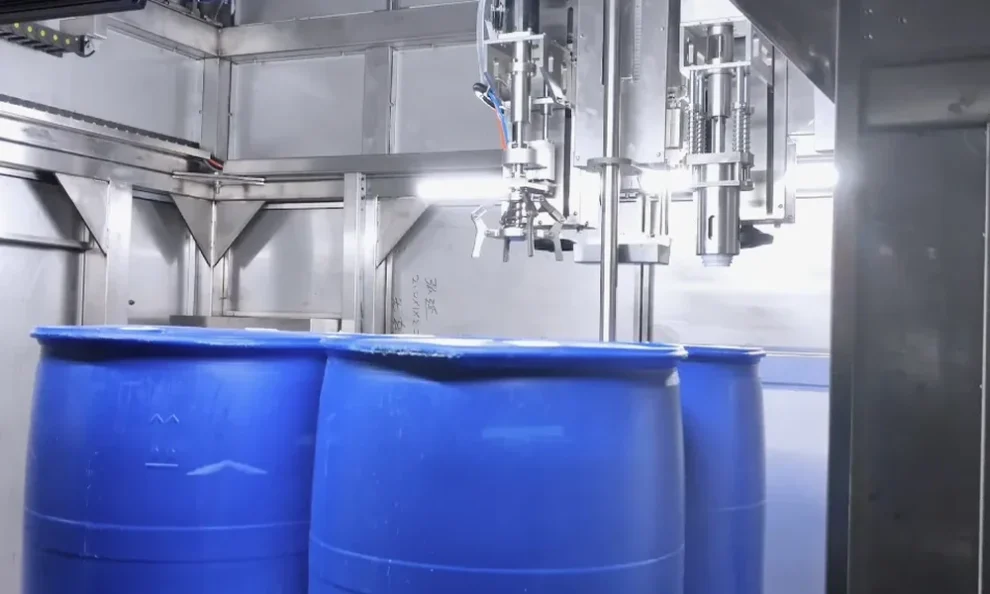

Drum filling systems in Singapore address a specific and demanding segment of the industrial packaging market. Drums, typically in the 200-litre range, are the standard bulk packaging format for chemical products, lubricants, paints, solvents, food-grade bulk ingredients, and a wide range of other industrial and food industry materials. Filling them accurately, safely, and efficiently requires equipment designed specifically for the challenges of drum filling rather than systems adapted from smaller container applications.
Why Drum Filling Is Demanding
Drum filling presents several specific challenges that distinguish it from the filling of smaller containers.
Weight and volume: A 200-litre drum filled with a product of water-like density weighs approximately 200 kilograms. The management of this weight through the filling process – positioning, filling, moving, and palletising – requires equipment and handling systems rated for these loads.
Accuracy at scale: An overfill of 1 percent in a 200-litre drum represents 2 litres of product – a significantly larger volume loss than the same percentage overfill in a 1-litre container. Drum filling accuracy requirements are correspondingly important to the economics of the filling operation.
Vapour management: Many products filled into drums – solvents, fuels, chemical intermediates – produce vapours that are either hazardous, flammable, or odorous. Drum filling systems must manage vapour containment, and in flammable product applications must be designed and certified as explosion-proof.
Product variety: A single drum filling operation may need to handle products varying widely in viscosity, corrosivity, and physical characteristics. The filling equipment must accommodate this range without compromising accuracy or safety for any product in the range.
Filling Methods for Drums
Bottom-up or submerged filling introduces the product into the drum through the bung opening with a fill tube that extends to the bottom of the drum. The product fills from the bottom upward, which reduces splashing and vapour generation compared to top-down filling. This method is preferred for volatile, flammable, or foaming products.
Top-fill via flow meter fills the drum from a nozzle above the drum opening, with flow measured by a calibrated flow meter that stops the fill at the target volume. This method is faster than bottom-up filling and is suitable for non-volatile, non-foaming products.
Gravimetric (weight-based) filling uses load cells under the drum to monitor the fill weight in real time and stop the fill at the target weight. This method provides the highest fill accuracy and compensates for product density variation between batches.
Safety Requirements
Drum filling systems in Singapore for chemical and flammable products must comply with relevant safety standards including those from the Singapore Civil Defence Force, which regulates the handling of flammable materials, and the Workplace Safety and Health Act requirements for safe equipment design.
As the Workplace Safety and Health Council notes in its guidelines on chemical handling, “Proper equipment design and operation are the first line of defence against chemical exposure and fire risks in liquid filling operations.” Drum filling equipment for hazardous materials must therefore be specified with the safety requirements as primary design criteria, not afterthoughts.
Specific safety features for hazardous drum filling include explosion-proof electrical components, earthing and bonding connections that prevent static build-up during filling of flammable liquids, vapour recovery systems, and emergency shut-off capability.
Accuracy and Batch Records
Accurate drum filling systems in Singapore for regulated industries generate batch records that document the fill weight or volume, the fill time, the operator, and the batch number for each drum produced. This documentation is a regulatory requirement in pharmaceutical and food manufacturing and a good manufacturing practice in chemical production.
Modern drum filling systems interface with manufacturing execution systems and enterprise resource planning platforms, allowing this documentation to be captured automatically without separate manual data entry.
IBC Filling
Intermediate Bulk Containers (IBCs) in the 1,000-litre range are increasingly used as an alternative to multiple drums for large-volume liquid products. IBC and drum filling systems from AF Advantech in Singapore serve both container formats, providing the flexibility to fill either format on the same equipment where the production mix requires it.
Selecting the Right System
The selection of drum filling systems for Singapore industrial operations must address product characteristics, safety classification, throughput requirements, accuracy standards, and documentation requirements together. An incorrectly specified system creates risks – to accuracy, to safety, to compliance – that the initial cost saving does not justify. Working with a specialist supplier who has experience with the specific product and container combination you need to fill is the most reliable approach to getting the specification right.