






The selection of the correct industrial timing belt for a specific application is a decision that affects the reliability, accuracy, and maintenance cost of the drive system across its entire service life. An incorrectly specified belt, whether in pitch, width, tension member, or material, will either underperform mechanically, fail prematurely, or impose an unnecessary cost penalty where a lower-specification belt would have served the application adequately. For maintenance engineers, OEM design teams, and procurement managers, understanding the technical parameters that govern timing belt selection reduces the risk of specification errors and improves the confidence with which replacement and redesign decisions are made.
What are the main types of industrial timing belts?
Industrial timing belts are available in two primary material categories, each suited to different application conditions:
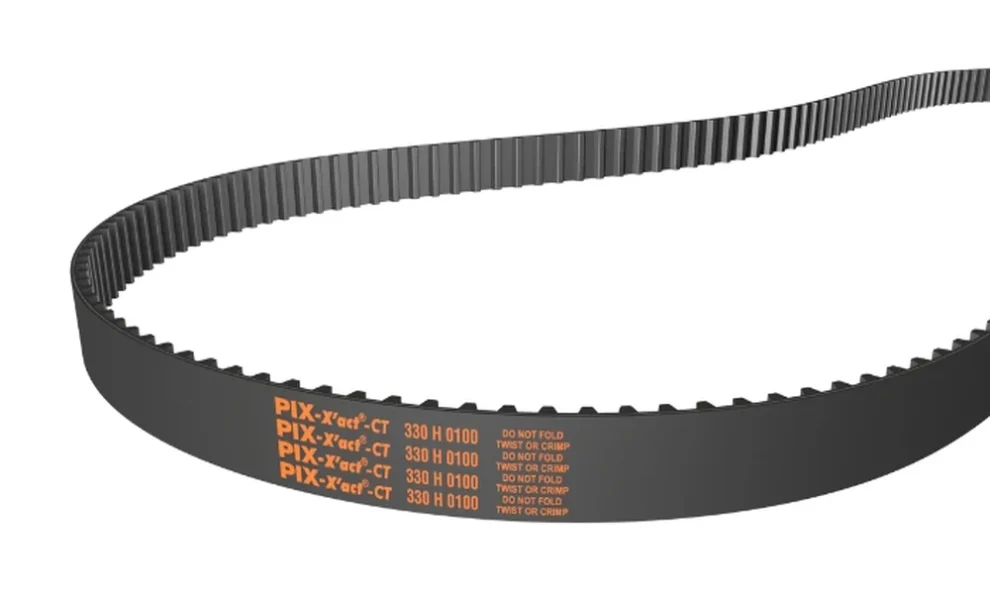
- Rubber timing belts: neoprene or EPDM-based belts reinforced with fibreglass or steel tension members, available in the full range of standard tooth profiles including trapezoidal (L, H, XH, XXH), curvilinear (HTD 3M, 5M, 8M, 14M), and AT profiles. Rubber timing belts are the standard choice for the majority of industrial drive applications where oil exposure is limited, operating temperatures are within the rubber’s range, and the cost of replacement is modest relative to the extended service intervals that the material supports.
- Polyurethane timing belts: cast or injection-moulded polyurethane belts with steel, Kevlar, or fibreglass tension members, available in the same tooth profiles as rubber belts and additionally in open-end strip form for linear positioning applications. Polyurethane belts are preferred where oil resistance, chemical resistance, dimensional stability, or food-grade compliance is required.
What is tooth profile and why does it matter?
The tooth profile of a timing belt determines the load distribution at the mesh with the pulley, the noise level during operation, and the maximum torque that the belt can transmit at a given width and pitch. The three principal profile families in industrial use are:
- Trapezoidal profiles (MXL, L, H, XH, XXH): the original timing belt profile, with straight-sided teeth that provide positive engagement with matching pulleys. Trapezoidal profiles remain in widespread use in lighter industrial applications and in OEM equipment designed before curvilinear profiles became the standard.
- Curvilinear profiles (HTD, GT, RPP): developed to improve load distribution and reduce the stress concentration at the tooth root that trapezoidal profiles produce under high torque. Curvilinear profiles carry higher torque per unit width than equivalent trapezoidal profiles and produce less noise at high speeds, making the option the preferred specification in new drive designs where torque capacity and noise are design constraints.
- AT profiles: a high-torque trapezoidal variant with a wider tooth and deeper engagement than standard trapezoidal profiles, used in applications where the positive engagement and positional accuracy of the timing drive need to be maintained under high tangential load.
What are the key parameters for timing belt selection?
The selection of the correct rubber timing belt or polyurethane belt for a specific application involves calculating or estimating several interacting parameters:
- Design power: the nominal power transmitted by the drive, multiplied by a service factor that accounts for the load variability, start-stop frequency, and the shock loading characteristics of the driven machine. The service factor is the most significant source of selection uncertainty because underestimating load variability leads to belt underspecification.
- Speed ratio and centre distance: the ratio of driver to driven pulley diameters and the centre distance between the pulleys determine the belt length, the arc of contact on the smaller pulley, and the tangential velocity at the pitch diameter, all of which affect the selection.
- Shaft load: timing belt drives generate shaft loads on the pulley bearings that must be within the bearing’s rated load capacity. Over-tensioning a belt, which is a common field error, increases shaft loads beyond design values and reduces bearing life.
- Environmental conditions: the operating temperature, the presence of oils or chemicals, the humidity, and whether the application requires food-grade or anti-static materials are the environmental inputs to the material selection
How do rubber timing belt manufacturers in India support selection?
Quality rubber timing belt manufacturers in India and the distributors representing international belt manufacturers provide technical selection tools including load calculation software, service factor tables, and the dimensional and performance data that engineering teams need to complete a drive design or to verify a proposed replacement specification. Manufacturers whose products are supported by comprehensive technical documentation and whose distributors can provide application-specific selection advice are more reliable sources for critical drive applications than commodity suppliers who stock belts without the supporting technical capability.
Alongside timing belt solutions, banded V belts are used in applications requiring multiple V-belt sections to operate together as a single drive unit. These belts can provide stable power transmission and improved load distribution in demanding industrial applications. Selecting the appropriate belt type requires consideration of factors such as drive configuration, load, operating speed, and application requirements.