






As warehouses and logistics centers continue to pursue higher efficiency and lower labor costs, automatic container loading systems are becoming an increasingly important investment. However, choosing the right system requires more than simply comparing prices or loading speeds.
Businesses should carefully evaluate operational needs, warehouse conditions, and long-term automation goals before making a purchasing decision.
1. Product Type and Packaging
The first thing to consider is the type of products your warehouse handles. Different loading systems are designed for different cargo types, including cartons, bags, pallets, drums, or irregular-shaped products.
For example:
- Vacuum gripper systems are suitable for cartons and boxed products
- Clamp-style systems work well for bags and soft packages
- Conveyor-assisted loading systems are ideal for continuous product flow
- Robotic loading systems can handle mixed-size packages with greater flexibility
Understanding your product dimensions, weight range, and packaging stability will help determine the most suitable loading technology.
2. Loading Capacity and Throughput Requirements
Every warehouse has different shipping volumes and operational demands. Before buying an automatic container loading system, businesses should evaluate:
- Daily container loading volume
- Peak-season shipment demands
- Average loading cycle time
- Required loading speed per hour
A system with insufficient throughput may create bottlenecks, while an oversized system could result in unnecessary investment costs.
High-volume distribution centers often require fully automated solutions capable of continuous operation with minimal downtime.
3. Warehouse Space and Layout
Available warehouse space is another critical factor. Some automated systems require large installation areas, while others are designed for compact warehouse environments.
Businesses should carefully assess:
- Dock positions
- Conveyor routing
- Ceiling height
- Floor space availability
- Existing equipment placement
A poorly planned installation can reduce operational efficiency and limit future warehouse expansion possibilities.
Modular and flexible systems are often preferred because they can adapt to changing warehouse layouts and operational requirements.
4. Integration with Existing Automation Systems
Modern warehouses usually rely on multiple automation technologies working together. Your new loading equipment should integrate smoothly with existing systems such as:
- Warehouse management systems (WMS)
- Conveyor lines
- Palletizers
- AGVs and AMRs
- Sorting systems
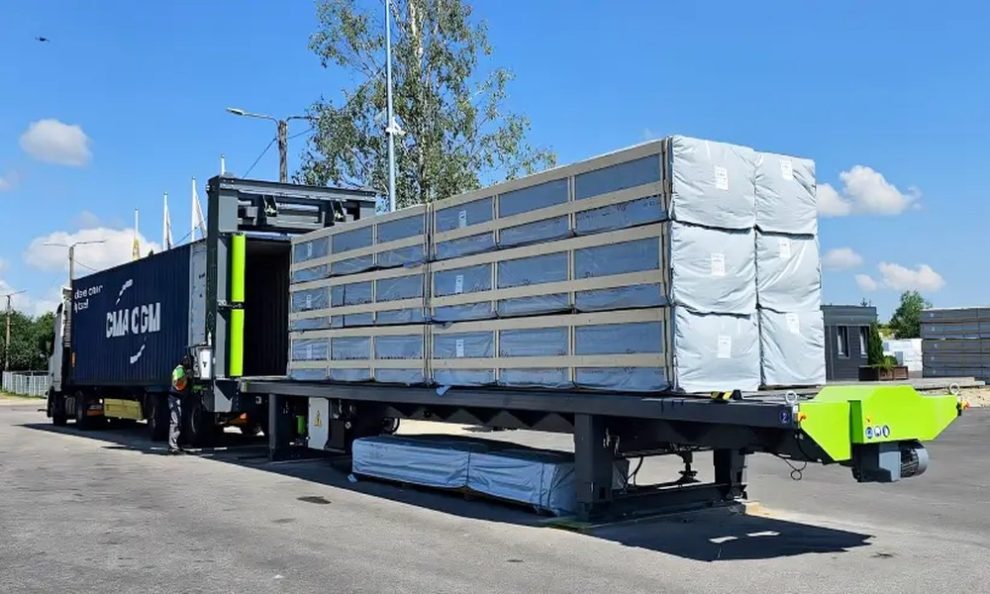
Some companies also integrate a complete Loading and Unloading System to create a seamless automated workflow for inbound and outbound logistics operations.
Good system integration improves efficiency, reduces manual intervention, and provides better operational visibility.
5. Automation Level and Flexibility
Automatic container loading systems are available in different automation levels, from semi-automatic equipment to fully robotic solutions.
Businesses should consider how much flexibility is needed for their operations. Questions to evaluate include:
- Will the product types change frequently?
- Are mixed-size cartons common?
- Does the warehouse handle seasonal product variations?
- Is future business expansion expected?
Flexible systems with AI vision technology and intelligent control capabilities can adapt more easily to changing logistics demands.
Although fully automated systems may require a higher initial investment, they often provide greater long-term efficiency and scalability.
6. Safety and Labor Considerations
Manual container loading is physically demanding and can increase the risk of workplace injuries. Automated loading systems help reduce repetitive lifting, bending, and heavy handling tasks.
When evaluating equipment, businesses should look for:
- Emergency stop systems
- Collision detection sensors
- Safety guarding
- Intelligent motion control
- Stable cargo handling performance
Improved safety conditions not only protect workers but also help reduce compensation costs and operational disruptions.
Additionally, automation can help businesses address ongoing labor shortages in warehouse and logistics industries.
7. Maintenance, Support, and ROI
Long-term reliability is just as important as initial performance. Before purchasing a system, companies should evaluate the supplier’s technical support and maintenance capabilities.
Important considerations include:
- Spare parts availability
- Remote troubleshooting support
- Operator training services
- Preventive maintenance programs
- Technical response time
Businesses should also analyze the expected return on investment (ROI). While automated loading systems require upfront investment, they can generate long-term savings through:
- Reduced labor costs
- Faster loading operations
- Lower product damage rates
- Higher warehouse productivity
- Reduced workplace injuries
For many high-volume warehouses, automation can significantly improve operational profitability over time.
The Growing Importance of Automated Loading Solutions
As global supply chains continue to evolve, businesses are under pressure to increase efficiency while reducing operational costs. Automated loading technologies are becoming essential tools for achieving these goals.
Many companies now invest in integrated Loading and Unloading System solutions that combine robotic loading, unloading, conveying, and warehouse automation technologies into one streamlined logistics process.
This approach improves operational coordination and supports smarter warehouse management strategies.
Conclusion
Choosing the right automatic container loading system requires careful evaluation of product types, warehouse layout, automation needs, safety requirements, and long-term operational goals.
The ideal solution should not only improve loading efficiency but also provide flexibility, reliability, and scalability for future business growth. By selecting the right automation partner and technology, warehouses can build safer, smarter, and more efficient logistics operations for the years ahead.